Our Approach to Pipeline Walking: Assessment and Mitigation
Overview
Pipeline walking is the gradual accumulation of axial displacement in surface-laid subsea pipelines subjected to repeated thermal and pressure cycles. It is most commonly associated with high-pressure, high-temperature (HPHT) developments where the pipeline is not fully restrained axially.
If not properly managed, pipeline walking can lead to excessive end expansion, over-rotation of tie-ins and in-line tees, and increased lateral displacement at planned buckle locations. The phenomenon may be driven by a combination of factors, including seabed slope, thermal transients, variations in internal fluid density, pipe-soil interaction, and riser tension.
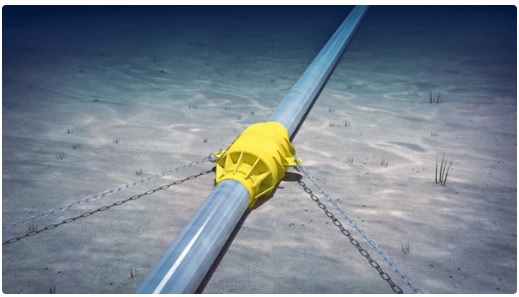
Mitigation measures are typically incorporated during the design phase through axial restraints or anchors. For pipelines already in operation, solutions such as standard or clamped concrete mattresses can be used to control further movement.
Our Assessment and Approach
We combine engineering judgement with advanced three-dimensional Abaqus finite element models and Python-enabled automation to quantify pipeline walking and evaluate mitigation strategies.
Our assessment begins by identifying the key drivers of axial displacement, including seabed slope, thermal and pressure cycling, multiphase flow conditions, pipe-soil interaction, tie-in configuration, and the presence of lateral buckles. These factors are incorporated into detailed numerical models that simulate pipeline behaviour over repeated operating cycles.
Particular attention is given to movement at tie-ins and in-line tees, where accumulated displacement can have the greatest operational impact. Pipe-soil interaction is modelled explicitly, including both drained and undrained conditions, to capture the influence of seabed behaviour on axial response.
The analysis considers both planned buckle mitigation and the potential impact of rogue buckles. Where relevant, berm formation at rogue buckle locations is included, as it can alter residual forces and redistribute loads along the pipeline. The evolution of buckle geometry is also simulated, providing insight into local deformation and global force redistribution.
Targeted sensitivity studies are performed to identify the parameters that most influence walking behaviour. Automated workflows enable efficient assessment of multiple operating scenarios and design options, supporting robust engineering decisions and effective mitigation strategies.
"We combine engineering judgement with Abaqus modelling and Python-enabled simulations to deliver practical, reliable solutions for pipeline walking."